What exterior detailing actually is
Exterior detailing is the careful, paint-safe cleaning of every outside surface on your vehicle: the paint, the glass, the wheels, the tires, the wheel wells, the trim, and the door jambs. It is followed by a protective layer — usually a sealant or a wax — that helps the vehicle stay cleaner longer and gives water somewhere to bead.
What separates an exterior detail from a drive-through wash is the level of care taken with the paint. A drive-through wash uses brushes that have touched thousands of vehicles before yours. Many of those brushes pick up grit, sand, and small debris that then drag across your clear coat. Over time, that creates the cobweb of fine scratches you see on dark paint in direct sunlight — called swirl marks. A proper exterior detail avoids all of that by using clean tools, clean water, and a method called the two-bucket wash.
The basic order matters: you do not start by scrubbing dirty paint. You start by removing as much loose contamination as possible without touching it. That means a pre-rinse, then a foam application, then a contact wash with clean mitts and clean water. Wheels, which are by far the dirtiest part of any vehicle, get cleaned separately so that brake dust does not end up on your paint mitts. Drying is done with soft microfiber towels, not by air or by letting the sun do it. Sealant goes on last, on a clean and dry surface.
At Refine, we follow that sequence on every exterior detail. We use a foam cannon for the pre-soak. We do a two-bucket contact wash. We clean wheels with dedicated wheel tools that never touch paint. We dry with microfiber. And we finish with a hydrophobic paint sealant that provides short-term protection — usually two to three months of beading and easier cleaning.
The biggest favor you can do your paint is to never put it through a drive-through wash again. The second biggest is to book a real exterior detail two to four times a year.
Who needs an exterior detail
A few clear scenarios where an exterior detail makes sense:
- The vehicle is dirty but the inside is fine. Maybe you just deep-cleaned the cabin yourself, or maybe you just had an interior detail. The outside is now the part that does not match. An exterior-only service is the right call.
- You want safe paint care without committing to a full detail. Sometimes you do not need the cabin touched. You just need the outside taken care of, the right way, by someone who is not going to swirl your clear coat.
- Pre-event cleanup. Going on a road trip, listing the car, having photos taken, picking up a date for prom. Anything where the outside needs to look right.
- Pollen season cleanup. Tennessee pollen season is brutal. The yellow-green dust gets into every seam, eats away at clear coat over time, and is genuinely difficult to remove with a quick rinse. A real exterior detail handles it.
- Post-winter rinse-down. Salt and road treatment leave residue on undercarriages and lower panels. A proper exterior detail removes that residue safely instead of scrubbing it in.
- Long-distance driving aftermath. Bug guts on the front bumper, tar on the rocker panels, road film everywhere. An exterior detail clears it without damaging the paint.
Where exterior detailing is not the right call: if you want your paint to look like new, with mirror reflection, no swirls, no scratches, you do not want an exterior detail. You want paint correction. The two are different services with different goals, different tools, and different prices. We cover that in the next section.
What to expect during the appointment
A full exterior detail at Refine takes 1.5 to 2.5 hours for most vehicles. Larger vehicles, dirtier vehicles, or vehicles with heavy contamination take longer. Here is the actual sequence.
Arrival and walkthrough. We meet you at the vehicle, look at the paint together, and confirm scope. If there is excessive tar, set-in bug damage, water spots, or anything else we should flag, we will do that now. We will also confirm there is a hose bib (or other water access) at the location, since exterior work uses meaningful water.
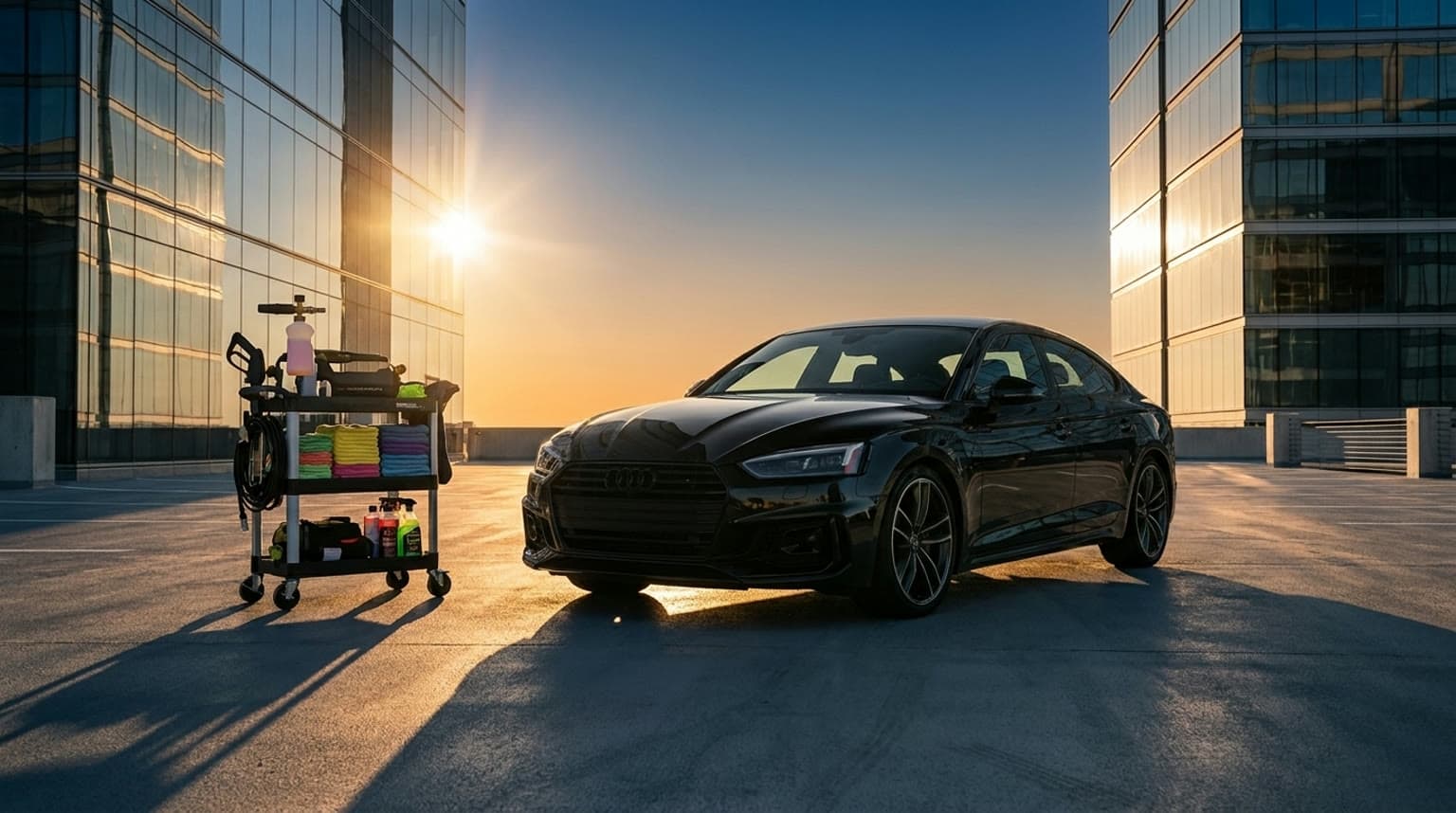
Setup. We pull out our wash gear: foam cannon, two buckets with grit guards, multiple wash mitts, dedicated wheel tools, drying towels, sealant, and tire dressing. Buckets are clean. Tools are clean. Water is fresh.
Wheels first. This is counter to what most drive-through washes do, but it is the right order. Wheels carry brake dust and road grime that is more abrasive than anything else on the vehicle. We clean wheel faces, accessible barrels, wheel wells, and tires before we touch the paint. Wheel tools stay separate from paint tools — they never cross-contaminate.
Pre-rinse. A thorough rinse from top to bottom to knock off as much loose dirt as possible. The less dirt you have to physically wipe off paint, the safer the wash is.
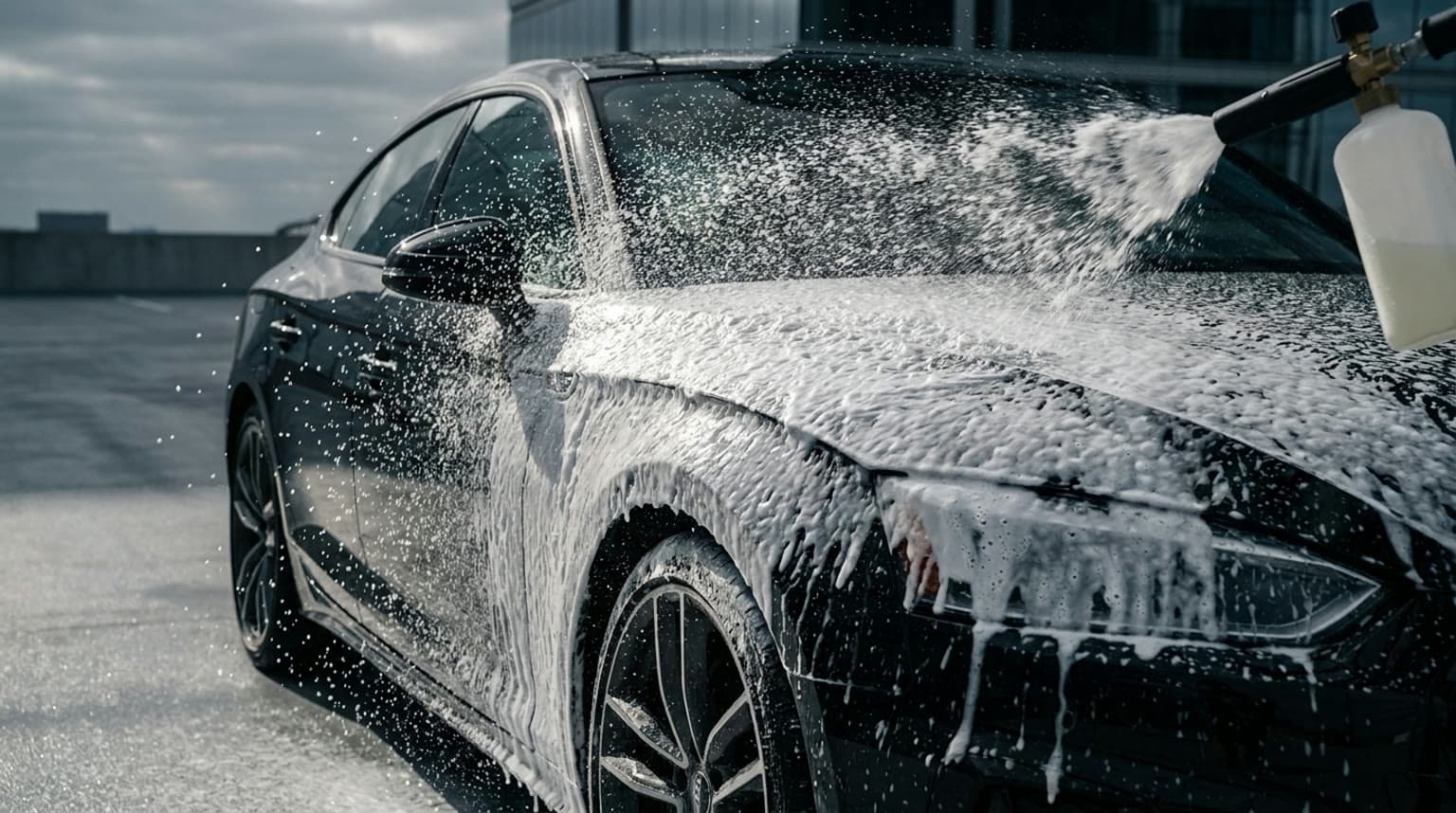
Foam application. A foam cannon applies a thick foam coat that dwells on the paint, softens contamination, and lifts dirt away from the surface before contact begins. You will see it on the vehicle for a few minutes.
Two-bucket contact wash. One bucket is your clean soap water. The other is your rinse bucket. Wash mitt goes into the soap, then onto the paint with light pressure, then into the rinse bucket to drop dirt before going back into the soap. This way you are never dragging the same grit across your paint twice. We wash one panel at a time, top down, rinsing as we go.
Bug and light tar removal as needed. Standard exterior includes light bug and tar work. Heavier contamination becomes an add-on, which we will confirm with you before doing.
Door jambs. Opened and wiped down so that closed-door view stays clean.
Final rinse. A complete rinse to remove all soap residue. Soap left to dry will leave water spots and streaks.
Drying with microfiber. Soft, large microfiber drying towels. We do not let the sun dry the paint. Air-drying or sun-drying causes water spots, especially with the mineral content in Middle Tennessee water.
Tire dressing. A non-greasy, even tire dressing for a clean, deep finish. Not a glossy splatter-on look.
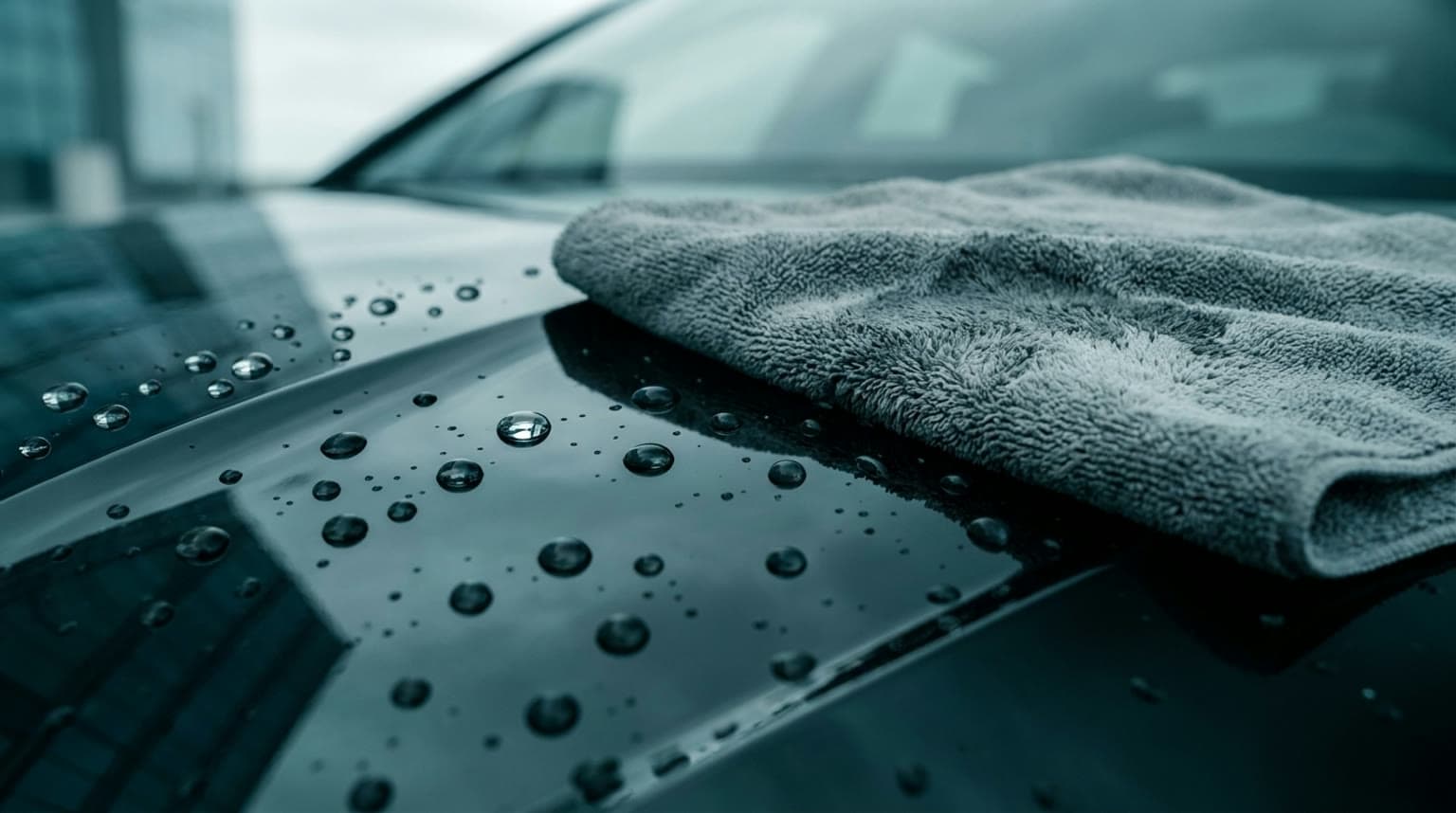
Hydrophobic paint sealant. Applied to clean, dry paint. The sealant gives you 2 to 3 months of water beading, easier next washes, and a subtle gloss. This is included in our exterior detail at no extra charge — most shops upcharge for sealant.
Final walkthrough. We walk the vehicle with you, point out anything notable, and confirm you are happy before wrapping up.
What exterior detailing can and cannot fix
This is where most exterior service descriptions get vague. Here is the specific version.
What an exterior detail can do:
- Safely remove dirt, road film, light salt residue, light tar, and bug residue from paint
- Restore the vehicle's clean, glossy appearance
- Clean wheels, tire sidewalls, wheel wells, and tires properly
- Remove water spots from a recent rain (not etched, long-set spots)
- Clean door jambs and trim
- Apply a sealant for short-term protection (2 to 3 months of beading)
- Make subsequent washes easier because the sealant repels dirt and water
- Improve curb appeal significantly
What an exterior detail cannot do:
- Remove swirl marks, fine scratches, or paint imperfections. Those are paint correction, which is a separate process involving compounding and polishing. We do not offer paint correction.
- Fix oxidation, fading, or clear coat failure. Those require either correction or repaint.
- Apply ceramic coating. Ceramic coatings are a multi-year protective layer that requires prep work, application time, and dedicated environment. We do not offer ceramic coating — we offer a hydrophobic sealant which is similar in concept but much shorter-lived.
- Remove deep water spots that have etched the clear coat. Light spots from a recent rain come off. Spots that have sat for weeks in the sun and bonded to the clear are now part of the paint.
- Fully remove paint transfer (e.g. from a scrape against a painted barrier). Some paint transfer comes off with detail clay or careful wiping; some is bonded.
- Repair physical damage — rock chips, door dings, scuffs, scratches that have broken the clear coat. Those need bodywork, not detailing.
- Guarantee zero water spots in every condition. We dry carefully, but Tennessee humidity and hard water can do unexpected things.
A real exterior detail makes your vehicle look like it does after a great wash. Paint correction makes it look like it did from the factory. These are not the same service.
Common myths and misconceptions
"A wax or sealant lasts a year." Some do, in lab conditions. In real driving with rain, sun, and washes, a sealant typically lasts 2 to 3 months. A ceramic coating lasts longer (1 to 5 years) but is a different product with a different application.
"Drive-through washes are fine if I do them often." Frequency makes it worse. Every drive-through pass adds micro-scratches. Over years, that adds up to visible swirling, especially on darker paint.
"You only need to wash when it looks dirty." Salt, pollen, and bird droppings damage paint while they sit. The longer they are there, the more they bond. Better to rinse more often than to wash less.
"Hand washing always swirls less than machine washing." Not necessarily. Hand washing with a dirty mitt swirls just as badly. Technique and clean tools matter more than method.
"All exterior details include paint correction." Almost none do. If a $100 exterior detail claims to include paint correction, it is not real paint correction. Paint correction is hours of careful machine work and starts at significantly higher price points than basic exterior detailing.
"Tire shine is just for looks." Quality tire dressings also help protect rubber from UV cracking. Cheap dressings leave a greasy mess and brown the sidewall over time. There is a difference.
How often you should book an exterior detail
The right cadence depends on where the vehicle lives:
- Garage-kept, daily driver, light use: 3 to 4 exterior details per year, ideally one each season.
- Outdoor-parked, daily driver, normal use: 4 to 6 exterior details per year. Tennessee weather earns it — pollen, summer heat, winter salt.
- Truck used for work, heavy contamination: every 6 to 8 weeks. Worth it.
- Vehicle that lives outside year-round in a high-pollen area: monthly exterior care in spring, less often in winter.
Between professional exterior details, a quick at-home rinse with a hose every couple of weeks is the best thing you can do — even just rinsing pollen and bird droppings off keeps your paint healthier than letting them sit. A quick rinse is not a wash, and that is fine. The sealant from your last exterior detail makes those rinses more effective because dirt comes off easier on a sealed surface.
What separates good exterior work from bad
A few specific things to look for during and after the service.
Two buckets, not one. A detailer with one bucket is reusing dirty water on your paint. This is the single biggest indicator of careful vs. lazy work.
Wheels are cleaned with separate tools. Wheel mitts and brushes should be visibly different from paint mitts. If the same mitt is being used on wheels and on paint, you have a problem.
Drying with microfiber, not chamois or air. Old-school chamois drag dirt. Air-drying causes spots. Quality drying towels are large, soft, and dedicated to drying.
Tire dressing is even and non-greasy. Run your finger along the sidewall after the job. It should feel finished, not slick. If your fingers come back with product on them, it was over-applied.
Door jambs and trim are clean. Open the doors after the job. Look at the rubber seals, the lower edges of the door, the area around the hinges. Clean here means clean everywhere.
No water spots on glass or paint. Some humidity-related spotting is unavoidable on a hot day. Significant spotting means the vehicle was rinsed and not properly dried.
The detailer acknowledged what would not improve. If you have swirls and the detailer says "I can make those go away with my wash," walk away. Swirls do not go away in a wash. That is correction work.
Add-ons worth considering
For the right vehicle, a few add-ons are worth thinking about:
- Excessive tar and bug removal — Standard exterior includes light tar and bug work. If you just drove I-65 through summer bug season, or your rocker panels are caked with tar from highway driving, the heavier removal is its own service. Priced from $25.
- Fluoropolymer glass sealant (front glass) — Hydrophobic treatment for your windshield. Improves wet-weather visibility because water beads and rolls off at highway speed, often without needing wipers. Front-glass only is $50.
- Full glass fluoropolymer sealant — Same product on all windows. $100. Worth it if you do a lot of highway or rain driving.
- Engine bay cleaning — Surface clean of the engine bay so it presents well. Useful before selling, before taking the vehicle to a shop, or just because. Starting at $40.
How much it costs and why
Exterior detailing at Refine starts at $80 for sedans, $110 for SUVs, and $140 for 3-row vehicles and trucks. These are starting prices for vehicles in average condition.
What drives price up:
- Size. More paint to wash, more wheels (well, the same number, but bigger).
- Heavy contamination. Excessive tar, heavy bug damage, neglected paint, road treatment buildup.
- Vehicle condition. A vehicle that has not been washed in a year takes more time than one washed last month.
- Add-ons — glass sealant, engine bay, tar removal, etc.
Why we include the sealant at no extra charge: it takes 10 minutes to apply on a sedan, the product cost is modest, and it makes the vehicle's clean condition last longer. Charging extra for it feels like an upsell, so we do not.
A note on cheap exterior washes: if you see a $30 "exterior detail" advertised somewhere, what you are really getting is a quick wash. There is nothing wrong with that if the scope matches. But it is not the same service as a careful two-bucket detail with sealant and proper wheel work. Both have a place.
Booking exterior detailing with Refine
We serve Murfreesboro, Smyrna, Franklin, Brentwood, La Vergne, Nashville, and surrounding Middle Tennessee areas. We come to you.
A quick honesty note: if your real goal is to fix swirls or restore depth to faded paint, an exterior detail is not going to do that. We will tell you honestly if you need correction work and refer you elsewhere if needed, instead of taking your money for a service that will not match your expectations.
If your goal is to get the vehicle clean, properly, with care for the paint, an exterior detail is the right service. Submit a quote request and we will confirm timing, pricing, and any vehicle-specific questions within 24 hours.